
In our earlier article about acquisition processes, we consciously took a different path from the mainstream M&A narrative, which typically treats mergers and acquisitions as a single topic. Rather than blending the two, we choose to focus on the acquisition side, aiming to expose the deeper I.C.E. layers that are often under-explored.
Today we continue the saga, this time talking about the Merger, sharing some insights we learnt over the time, starting by its meaning.
What does it mean?
Widely accepted definition of a merger would be; an occasion when 2 or more companies or organizations join together to make one larger company.
So it looks quite straight forward to understand what happens on a Merging operation (at least in theory).
In many cases, a merger follows shortly after the acquisition of a company, which is why the two are often analyzed together—an approach that is reasonable to some extent. However, since this is not always the case and in the interest of a more in-depth exploration, this article will treat just mergers, aiming to examine their core aspects independently. If you are interested in acquisitions you can check our previous article (click on the link).
Why do 2 companies merge?
There are a bunch of reasons for a merger to happen, (Growth, efficiency, diversification, competitive advantage, Economies of scope, entrance to new markets,…). But in our experience, every merger-without exception- is driven by 3 fundamental factors or goals, which may appear individually or in combination.
- Financial goals (F)
- Market goals (M)
- Technological goals (T)
Could it be that simple?
Let’s see what we mean by this statement, Financial goals could be defined as all the reasons related to Economic Efficiency (asset allocations, avoiding duplicity of costs, getting advantage of Economies of Scales, gaining access to capital or debt markets, tax benefits, etc). We define Market goals as those mainly focused on external growth; such as increasing brand awareness or presence in a new or different market, diversification, compliance, speed to market, entering new industries or customers, among others could be example of this goal. And Finally, Technological goals are the ones with clear objective of taking advantage of the Know-How, Technology, R&D, intellectual property, operational and process intelligence, data-and-analytics, etc.
With the combination of those 3 factors we could define all mergers you could imagine. Let’s see it graphically:
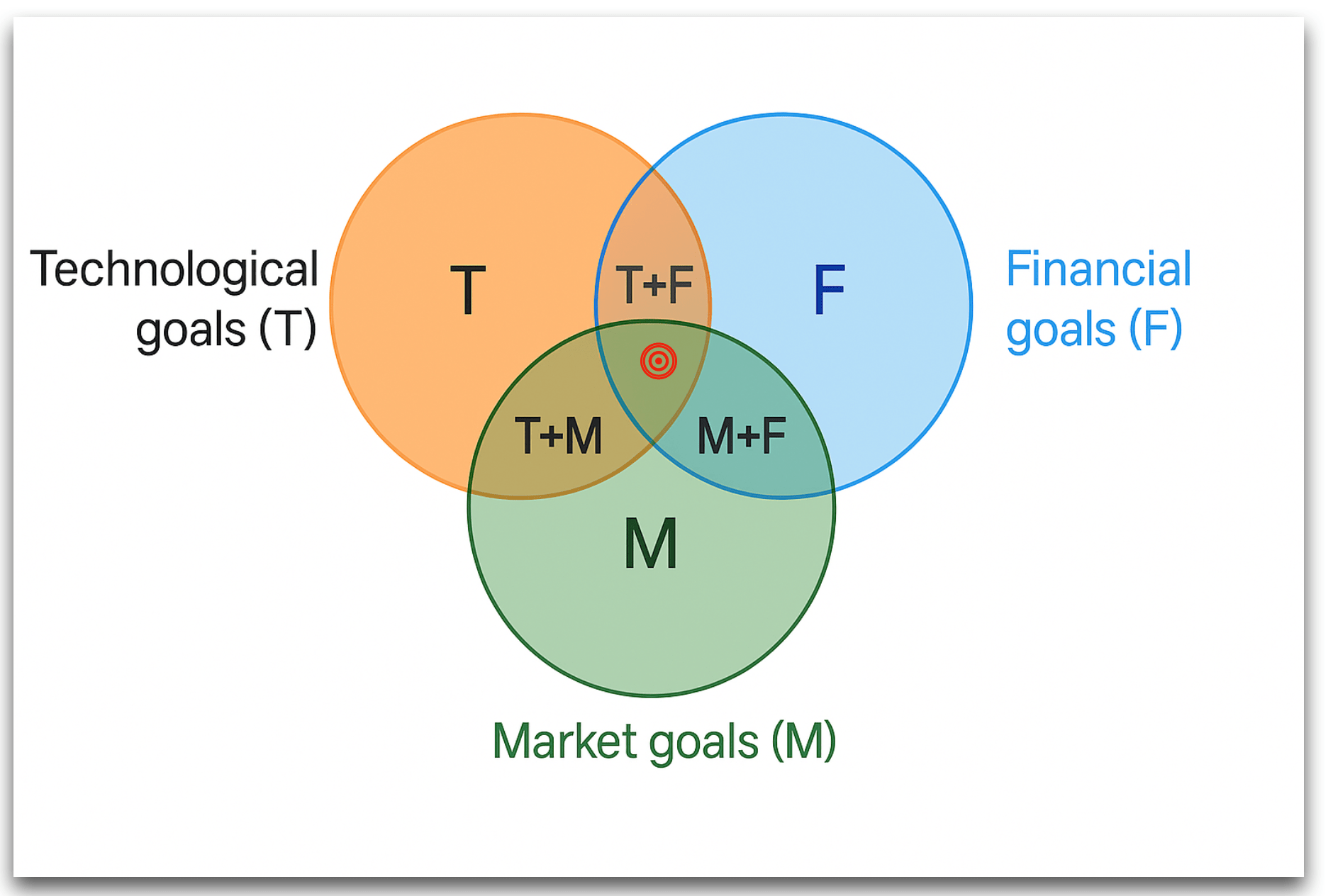
Let’s take a simple example; The Company’s management has decided to start a merger process of 2 of subsidiaries, part of the same group, competing in the same sector, in order to avoid competition between both brands and in order to optimized resources by eliminating inefficiency and costs for duplicated operations. Our merger will be positioned within the M+F area, and depending on the priorities we set, shifting more toward M or F dimension.
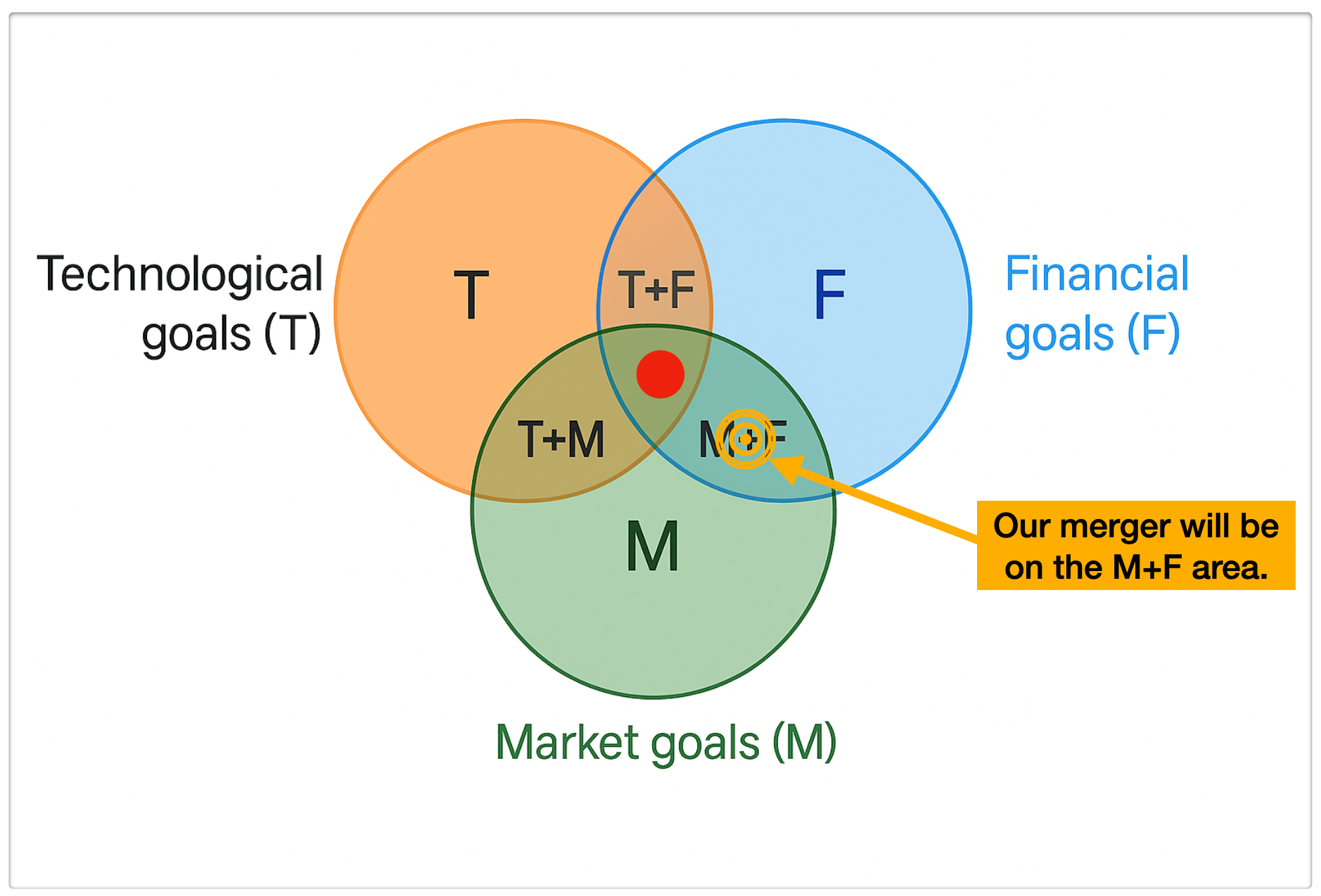
There’s a particularly interesting zone (marked with red point) at the intersection of the three objectives—what we refer to as the TMF area. Within our team, we also call this «The Management Faulty Area”.
This refers to the strategic deadlock where companies- and particularly their senior leadership and strategists- struggle to prioritize among the three core drivers mentioned above, unable to determine which factor should take precedence.
So, while this area might seem ideal in theory, in practice, since resources are finite, treating all goals as equally important ultimately results in a lack of clear prioritization and direction of merger process.
Now that we have a big picture in place, let’s take a closer look to the subject,
What are the key factors for a merger?
Establishing a clear hierarchy of the three drivers above—and communicating it effectively to the deployment team—is the foundation for a successful execution. But yet not enough unless Intelligence, Capital and Emotions triggered by the merger are not properly addressed.
We introduced these concepts in the context of acquisitions, where they were important—but in mergers, they become critical. That’s because the deployment ultimately results in a single legal entity, which significantly amplifies their impact. Let’s remember:
- Intelligence: Know-how accumulated by each company during years of being in the market.
- Capital: Among others we highlight, Human Capital (Value derived from the skills, knowledge, experience, and abilities of employees) and Intelectual Capital (The intangible value of a company’s intellectual property, such as patents, trademarks, copyrights, and trade secrets.,).
- Emotions: Emotional impact on the staff: their fears, uncertainties, and resilience in the face of the change.
In summary, correct definition of the relative weight of T, M and F factors and the right management of the Intelligence, Capital and Emotions together with a clear communication to the whole team- which includes members from both merging companies,- is what determines the success.
Do you agree with this point of view? What would you change? What you would do differently? Join the conversation—your insights are welcome.